Direct answer
Turn a villa defect list into a maintenance plan by separating observations from diagnoses, confirming which issues need specialist investigation, ranking the consequences of delay, and grouping work by cause and access. Each item should show its location, evidence, current condition, likely or confirmed cause, immediate controls if any, proposed investigation, repair boundary, responsible specialist and verification step. The plan should also reveal dependencies: fixing a stain before resolving water entry, or repainting before movement has been assessed, turns the list into repeated cosmetic work rather than coordinated maintenance.
Record what is observed before naming the cause
Describe location, size, pattern, timing and change. A crack near an opening, staining below a roof edge or intermittent equipment fault may have several possible causes. Photographs with dates, simple location references and notes about weather or operation create a useful baseline. Label the cause as confirmed, probable or unknown rather than presenting a guess as fact. Where safety, structure, electricity, gas, active leakage or other high-consequence conditions may be involved, refer the issue promptly to an appropriately qualified professional instead of extending a general maintenance checklist into diagnosis.
Use a four-part priority framework
Review each item through consequence, activity, evidence and dependency. Consequence asks what could happen if the issue is left. Activity asks whether it is stable, intermittent or worsening. Evidence asks how confident the diagnosis is. Dependency asks whether another inspection or repair must occur first. This produces more useful categories than urgent and non-urgent. One defect may need immediate professional isolation; another may need monitoring; a third may be bundled with planned access; a fourth may remain cosmetic until the owner chooses to renew the surrounding finish.
- Immediate professional response where safety or rapid damage is credible
- Investigate soon where cause is uncertain or the condition is active
- Plan with related work where access and preparation can be shared
- Monitor with dates and triggers where movement is not yet established
- Cosmetic renewal only after the underlying condition is resolved
Group by cause and access, not only by room
Several visible defects can originate from one shared interface, while two marks in the same room may be unrelated. Group work where there is a defensible connection: roof-edge investigation, wet-area waterproofing interface, facade movement review, air-conditioning condensate path or a repeated access zone. Then coordinate protection, isolation, opening-up and reinstatement once. Keep unrelated diagnoses separate so one contractor's assumption does not become the scope for everything nearby. The groupings should remain provisional until evidence supports them.
Planning example
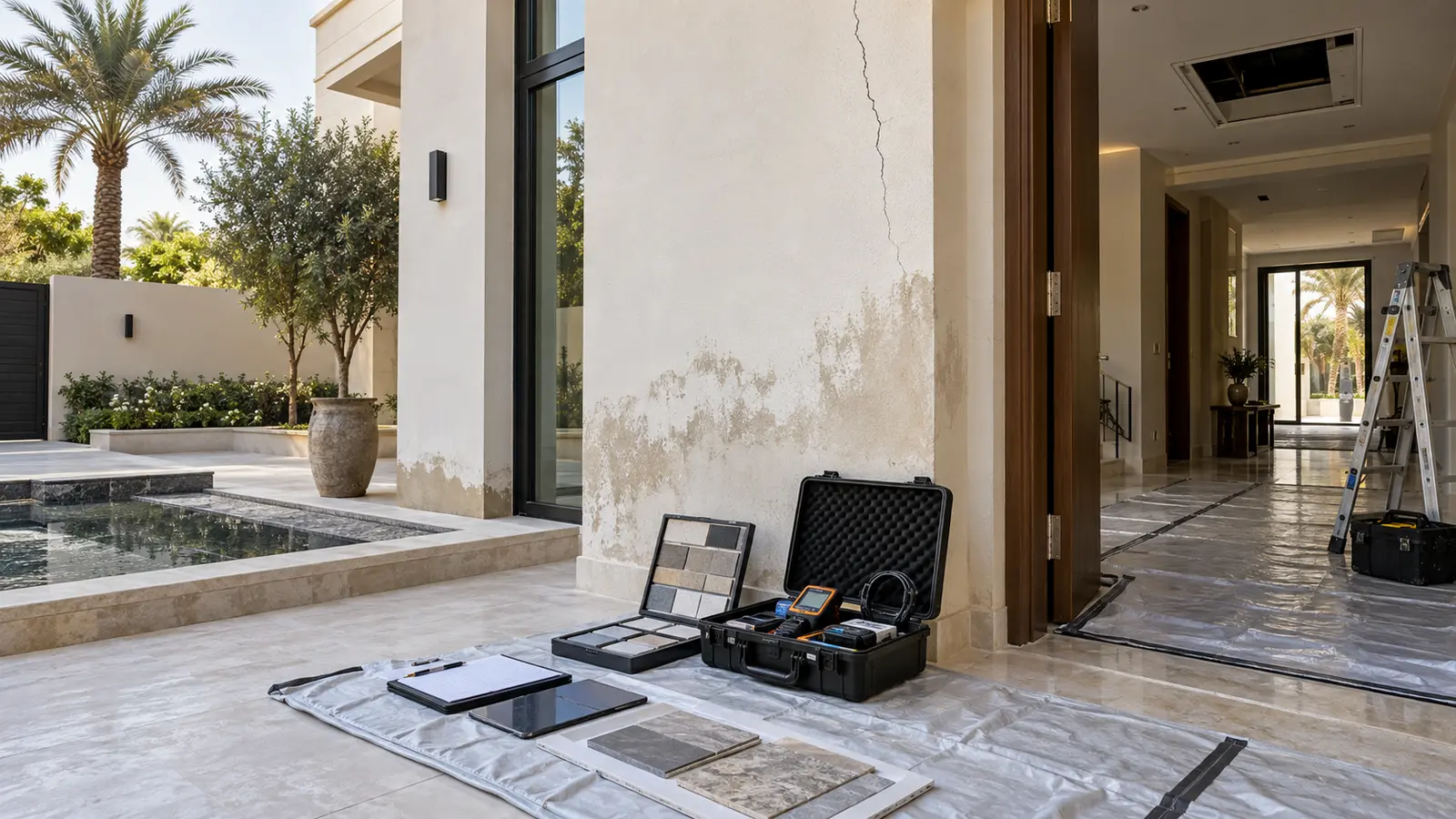
Planning example: a villa list contains a ceiling stain, flaking exterior paint, two hairline cracks and a noisy fan. Instead of issuing four isolated repair orders, the team records when each symptom appears and inspects the accessible interfaces. The ceiling stain and exterior paint loss are treated as one investigation package only after evidence suggests a shared water route. The cracks are photographed and referred for appropriate assessment before decoration. The fan is a separate service item with its own access and product information. The plan then sequences investigation, controlled opening-up, cause repair, verification and making-good. This is a planning example, not a diagnosis or completed-project claim.
Maintenance-plan checklist
A useful plan is readable by the owner, consultant and contractor. Give every item a stable reference number and preserve the history when its status changes. Record what was inspected and what remained concealed. If a product or system is involved, include the available manufacturer reference and installation history. Verification should match the issue: observation after weather, a professional test, a commissioning result or an agreed monitoring period may be more meaningful than a photograph taken immediately after making-good.
- Stable item number, exact location and dated photographs
- Observed symptom separated from likely or confirmed cause
- Priority based on consequence, activity and evidence
- Required specialist and investigation scope
- Related items that share access or preparation
- Protection, isolation and occupant-access constraints
- Repair boundary, making-good and retained finishes
- Verification method, owner and closeout record
Limitations and safety boundaries
A visual defect list cannot establish structural adequacy, hidden moisture paths, electrical safety, gas safety, waterproofing performance or equipment condition. Do not use it as a do-it-yourself repair manual. Site-specific inspections, competent specialists, current product instructions and applicable authority or community requirements govern the work. Some investigations require opening-up, access equipment or service isolation and must be planned safely. Absence of visible damage does not prove the absence of a concealed problem, while a visible crack or stain does not by itself prove a single cause.
Next step
Create a single defect register and review it with the appropriate project lead before requesting repair prices. Ask the team to mark evidence confidence, priority, investigation owner, repair dependency and verification for each item. Price confirmed repairs separately from provisional opening-up and cosmetic renewal. This creates comparable scopes, protects newer finishes from premature work and gives the owner a maintenance record that can be updated rather than recreated.
Sources & further reading
Make this useful for your project.
A review of your property and priorities can turn general guidance into a defined brief.
Explore Villa MaintenanceDiscuss your project