Direct answer
Before electrical work starts, a villa EV-charger brief should identify the actual vehicle or likely vehicle class, daily travel, parking position, charging window, desired future flexibility and who will manage access. It should also record the proposed charger location, cable reach, shade and weather exposure, route to the electrical supply, protection from vehicle impact, network connectivity and the approvals or notifications that apply. The charger model must not be selected in isolation from an assessment of the villa's electrical installation. DEWA's regulatory framework and technical regulations govern charging infrastructure within its jurisdiction, so the appointed qualified team should confirm the current process and compliant design before procurement or installation.
Define the charging need before the hardware
Start with use rather than headline charging speed. Record the vehicle's supported charging input from its official documentation, typical distance travelled, state of charge on arrival, time parked at home and how often a rapid turnaround is genuinely needed. A car parked overnight may not need the highest theoretical output. Also ask whether visitors, a future second vehicle or a change in parking bay is plausible. Distinguish a current requirement from a future allowance so the design does not over-promise capacity. The result should be a short operating brief that an electrical professional can test against the existing installation, rather than a shopping list copied from a charger advertisement.
Use a six-part readiness framework
Review six connected topics: vehicle compatibility; electrical capacity; physical route; charger position; user control; and approvals. Compatibility covers connector and manufacturer requirements. Capacity covers the existing supply, distribution equipment and other significant loads. Route covers cable length, containment and future access. Position covers reach, heat, weather, drainage and collision risk. Control covers authorised users, scheduling, connectivity and any load-management function. Approvals cover DEWA, building, community or landlord requirements that apply to the specific property. A proposal is not ready simply because the charger fits on a wall. Each topic needs an owner, evidence and a clear status before work is instructed.
Commission an electrical assessment
The appointed qualified electrical party should inspect the relevant supply and distribution equipment, review available capacity and diversity, confirm the proposed circuit and protection concept, and check the charger's current manufacturer documentation. This article does not provide installation steps. Private charging equipment is safety-critical electrical infrastructure, and DEWA's published framework states that applicable procedures, approval and technical regulations must be followed. If load management is proposed, define what it monitors, how it behaves when household demand rises and what happens if communication fails. Keep the assessment, approved information, test records and product documentation with the villa's project file so maintenance is based on the installed arrangement.
Design the parking interface, not just the wall point
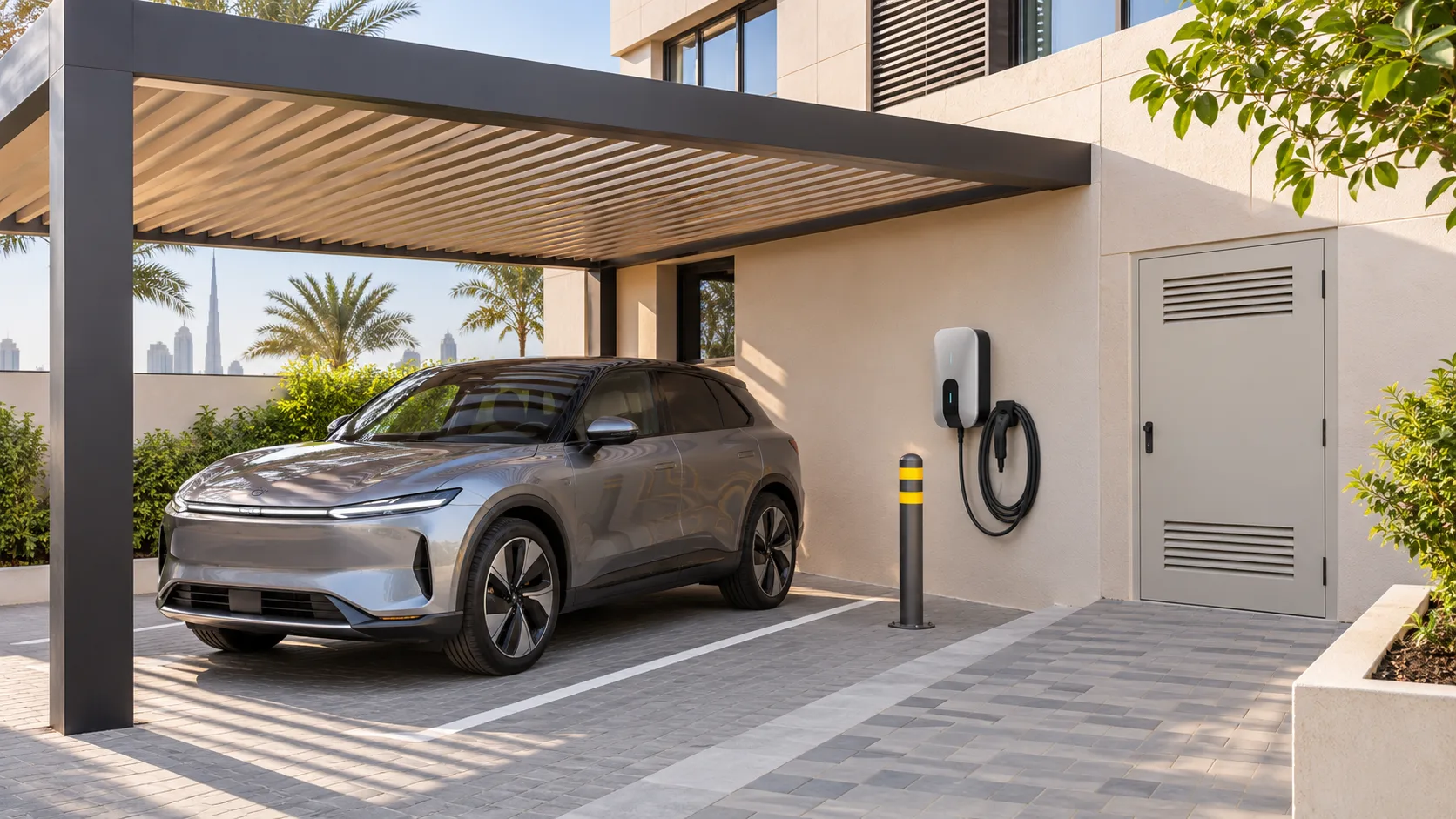
Park the actual vehicle, or use verified dimensions and inlet location, before fixing the charger position. The connector should reach without pulling tightly across the bodywork or crossing the normal route to the front door. Provide a logical holster position and consider protection where a reversing vehicle could strike the equipment. Shade may improve user comfort and reduce direct solar exposure, but any canopy or enclosure must preserve the equipment's required environmental and ventilation conditions. Do not place the charger where irrigation, standing water, a swinging gate, stored bins or routine washing will create avoidable conflict. Maintain clear access to electrical cabinets, utility spaces and emergency routes.
Planning example
A family has one electric SUV parked overnight in the left carport bay and expects a second electric vehicle within several years. The brief records the current car's inlet position, typical overnight dwell time and the family's preference for scheduled home charging. A qualified electrical consultant is asked to assess capacity and current DEWA requirements. Instead of assuming two chargers, the design reserves an accessible route and wall zone for the second bay while the present solution is sized from verified demand. The charger is positioned under the shaded carport, clear of the gate swing and pedestrian line, with a cable holster beside the bay and impact protection where appropriate. This planning example does not assume approval, capacity or a particular charging rate.
Buyer checklist before procurement
Use this list to test whether quotations are describing the same scope. Ask suppliers to state exclusions and the information still needed, especially where utility approval, civil work, connectivity or load management is involved.
- Record the exact vehicle model, supported input and inlet position
- Describe daily distance, parking duration and genuine turnaround requirement
- Obtain a qualified assessment of existing electrical capacity and equipment
- Confirm the current DEWA and any community or building process
- Check charger reach, holster position, shade, drainage and vehicle-impact risk
- Keep doors, gates, paths, utility cabinets and maintenance zones clear
- Define access control, scheduling, connectivity and failure behaviour
- Retain approvals, manufacturer data, test records and commissioning information
Limitations and a useful next step
Electrical capacity, approval routes and equipment requirements vary by property and can change. A visually similar neighbouring villa is not evidence that the same charger, route or process applies. Vehicle and charger manufacturers may also revise compatibility and installation information. Do not undertake electrical work, alter utility equipment or rely on an informal load estimate. The next step is to prepare a one-page charging-use brief with vehicle details, parking photographs, a simple bay plan and future expectations. Give it to an appropriately qualified electrical professional or project team for a site-specific assessment against current DEWA regulations, manufacturer instructions and any applicable community requirements before ordering equipment.
Sources & further reading
Make this useful for your project.
A review of your property and priorities can turn general guidance into a defined brief.
Explore Smart home upgradesDiscuss your project